



Anyone with even a passing interest in fashion knows what the first Monday in May signifies. For everyone else, the Met Gala is the annual ritual with which the Costume Institute opens its exhibition at the Metropolitan Museum of Art — an occasion that extends far beyond the museum setting to become one of the key barometers of contemporary visual culture. This year, under the title “Costume Art” and the dress code “Fashion is Art”, the exhibition frames fashion as an artistic discipline in dialogue with other creative languages, placing the dressed body firmly at its centre.
This year, the carpet arrives in a beige, cream-toned palette, lending the evening a more restrained, almost museological feel that aligns with the exhibition’s concept. Across it gather some of the most influential figures in global culture — from film to music to fashion — in a night where every look is filtered through a visual and symbolic lens.
Still, when it comes to menswear, the overall reading leans more restrained than expected. Far from the experimentation or conceptual excess often associated with the event, most looks have opted for refinement over risk: elegant, impeccably executed, but largely contained in ambition. A strong showing, but one that leaves the sense that the theme invited more.
Even so, within that restraint, several men managed to stand out — those who understood both the moment and its language. The names that follow define that exception:
Colman Domingo
Few figures are as consistently anticipated on the Met Gala carpet as Colman Domingo. The American actor and filmmaker has turned each appearance into a deliberate exercise in style, approaching the brief with intent and narrative precision.
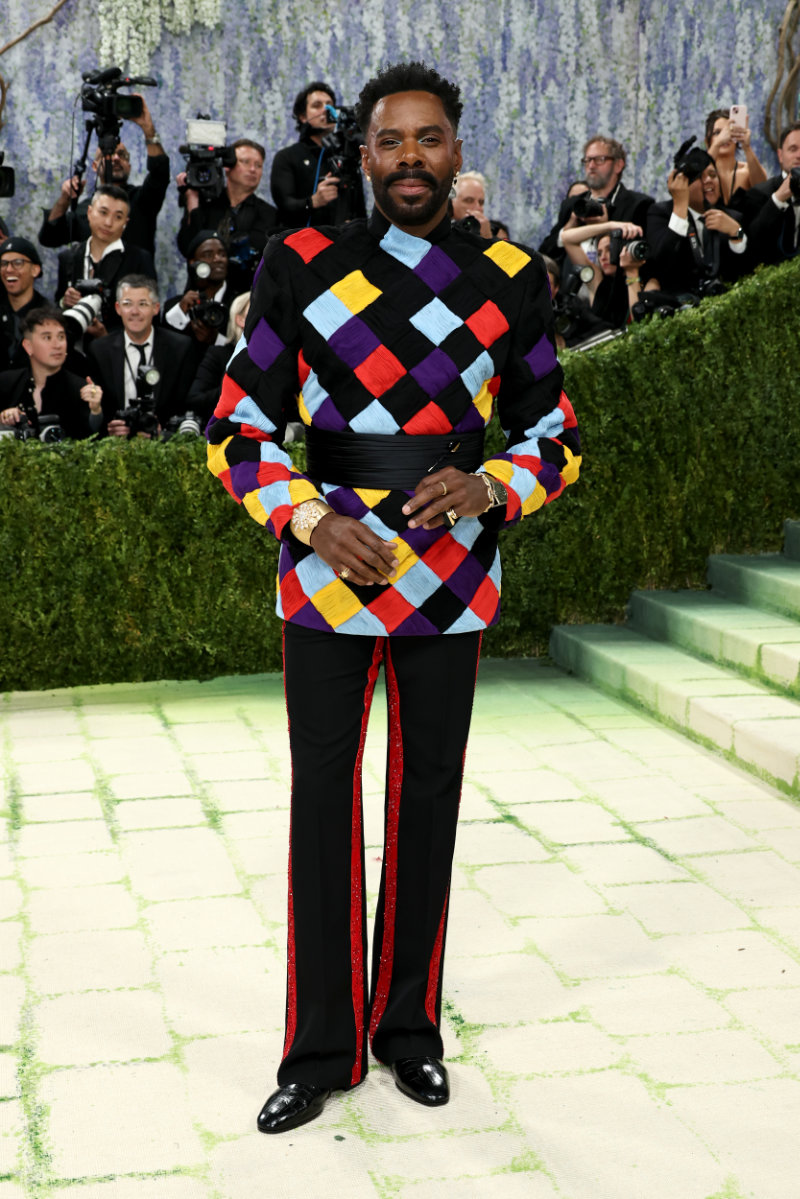
A long-standing Valentino ambassador, he once again joined forces with Alessandro Michele on one of the most resolved looks of the evening. A pleated chiffon jacket woven with the house’s harlequin motif was structured with a hand-pleated black satin waistband and paired with black wool bootcut trousers detailed with red satin side bands embroidered with beads and sequins — a composition where craft and storytelling operated in tandem.
In a night defined by restraint, Domingo distinguished himself through clarity: narrative intent, controlled risk, and a reading of fashion as artistic language. A look that expanded the theme rather than simply acknowledging it.
Joe Alwyn
Joe Alwyn offered a quieter interpretation of the brief, favouring proportion and material refinement over spectacle. The British actor relied on silhouette and texture rather than overt gesture.
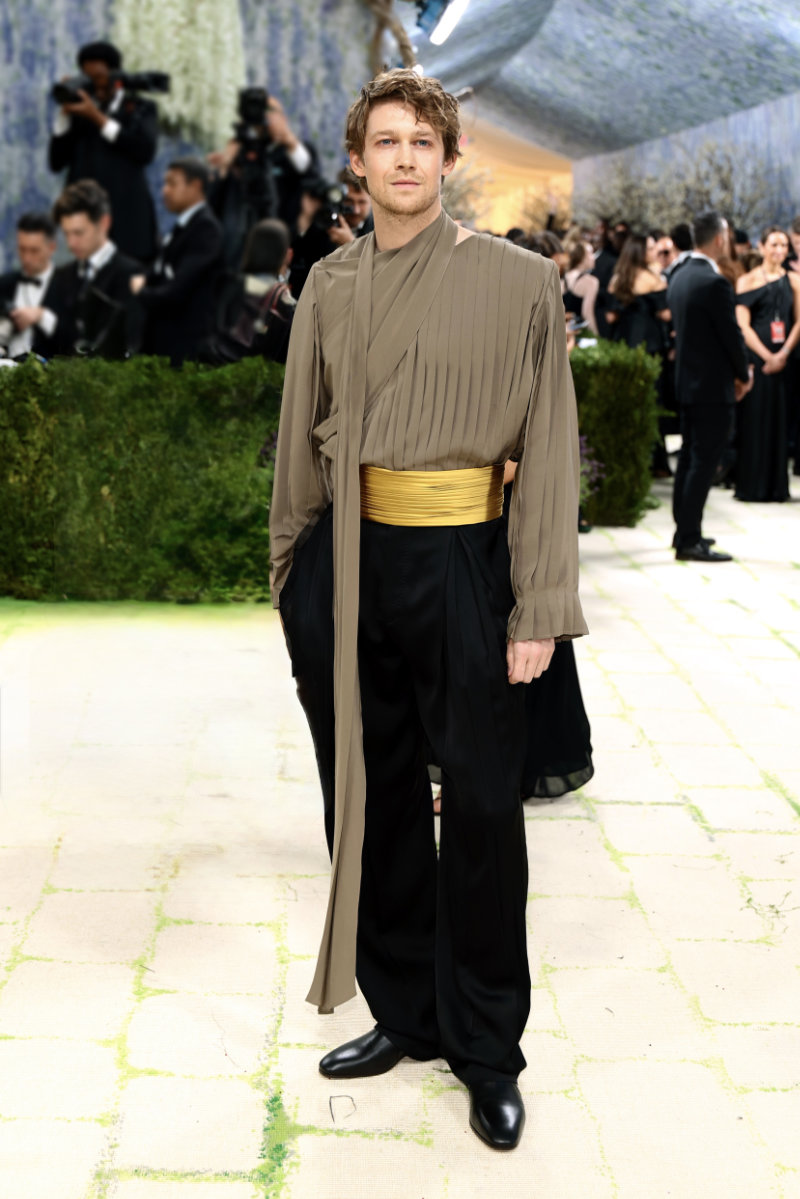
Working again with Valentino under Alessandro Michele, he appeared in a bespoke ensemble built around a hand-pleated taupe crepe de chine shirt with a softly draped neckline. This was structured with a pleated geranium satin belt — reimagined as a sculptural element — and paired with black satin cady trousers featuring a front pleat, elongating the silhouette with subtle control.
Its strength lay in balance: restrained, precise, and carefully resolved. In a landscape of safe tailoring, Alwyn introduced quiet tension through proportion rather than emphasis.
Nicholas Hoult
Nicholas Hoult delivered one of the most coherent readings of contemporary menswear, working once again with Prada under Miuccia Prada and Raf Simons. The result reflected the house’s ongoing interest in material contrast and modern tailoring.
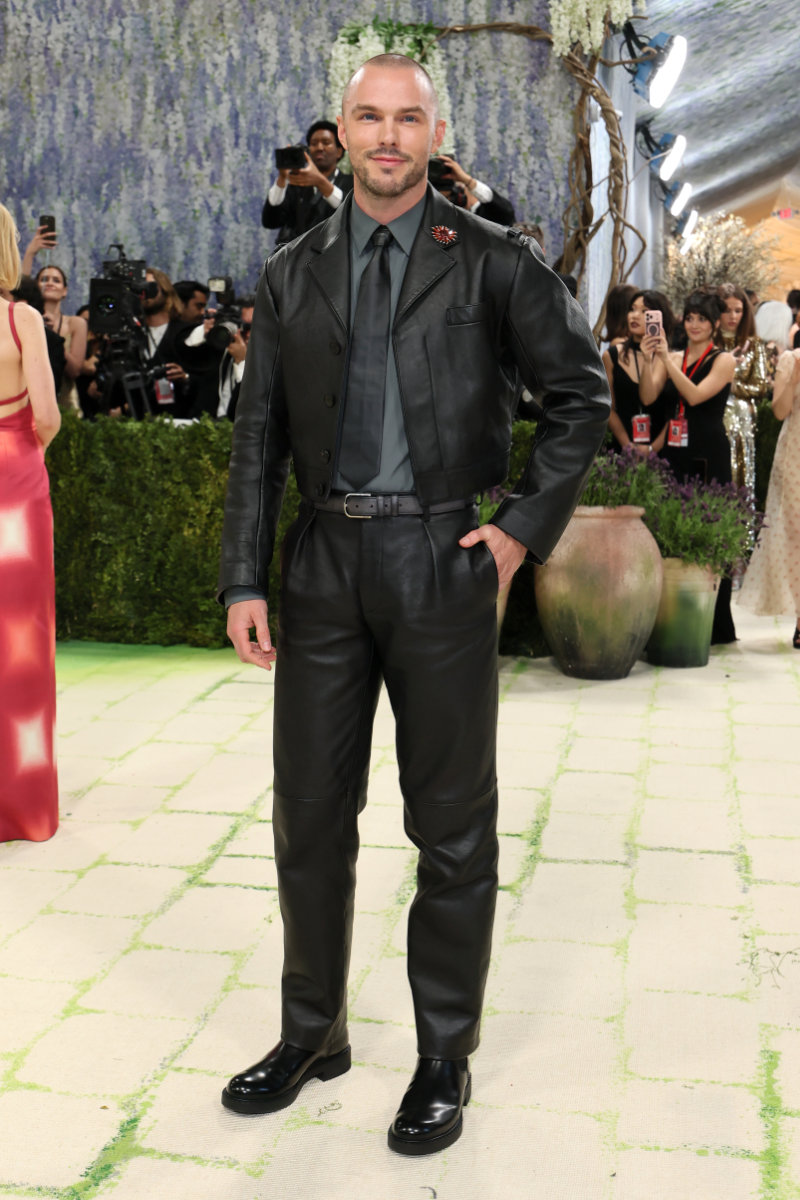
A black leather jacket formed the base, layered over a grey poplin shirt and paired with black mohair trousers detailed with a leather side band. Rather than ornamentation, the impact came from texture — leather, mohair, and poplin interacting in controlled tension. A grey leather belt and black leather tie reinforced the tonal discipline, while rounded-toe boots anchored the silhouette.
The result felt precise and composed, driven by material dialogue rather than excess. Through Prada, Hoult presented a look defined by clarity and restraint.
Bill Skarsgård
Bill Skarsgård returned to Thom Browne, a collaboration rooted in conceptual tailoring and narrative construction. The American house delivered one of its most structurally complex proposals of the evening.
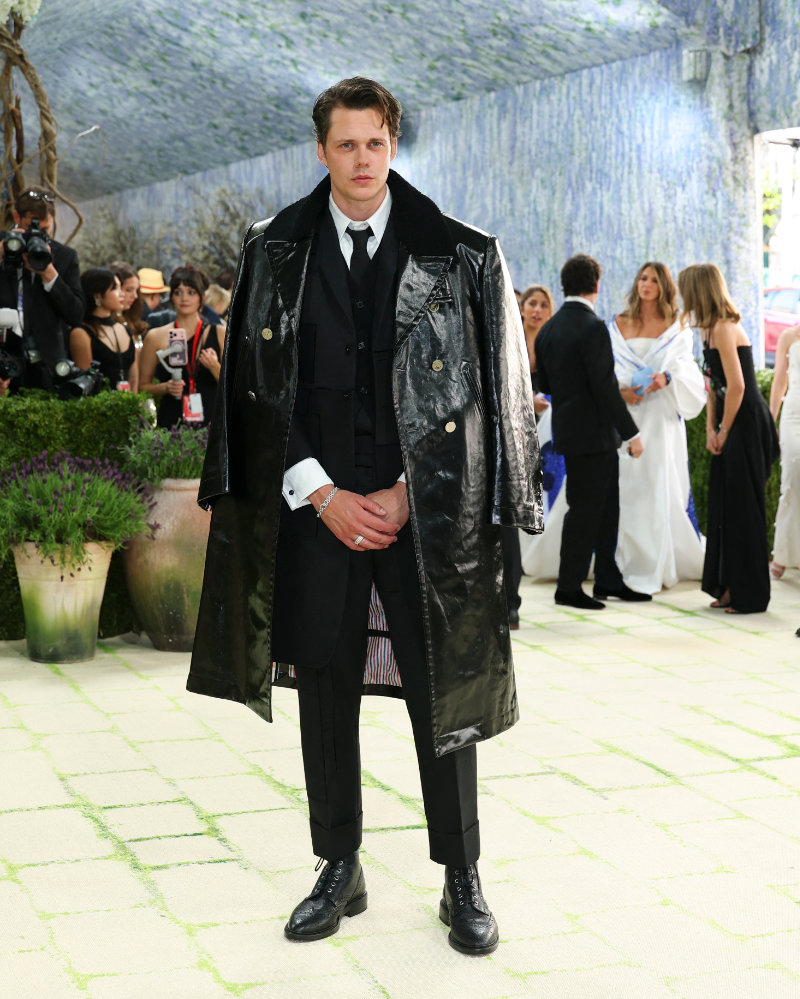
An elongated patchwork tuxedo in wool and silk satin was layered over a black cashmere vest and framed by an oversized peacoat in coated cotton with a shearling collar. Shifts in proportion — shortened sleeves, exposed cuffs, and layered panels — introduced controlled fragmentation within a disciplined structure. Hand-stitched archival fabrics reinforced the house’s material language.
Framed through the idea of the “ageing body,” the look unfolded as a study of time, erosion, and reconstruction, where tailoring becomes a process rather than an object.
Finn Wolfhard
Finn Wolfhard extended Thom Browne’s conceptual language into a younger register, maintaining its focus on construction and material reconfiguration.
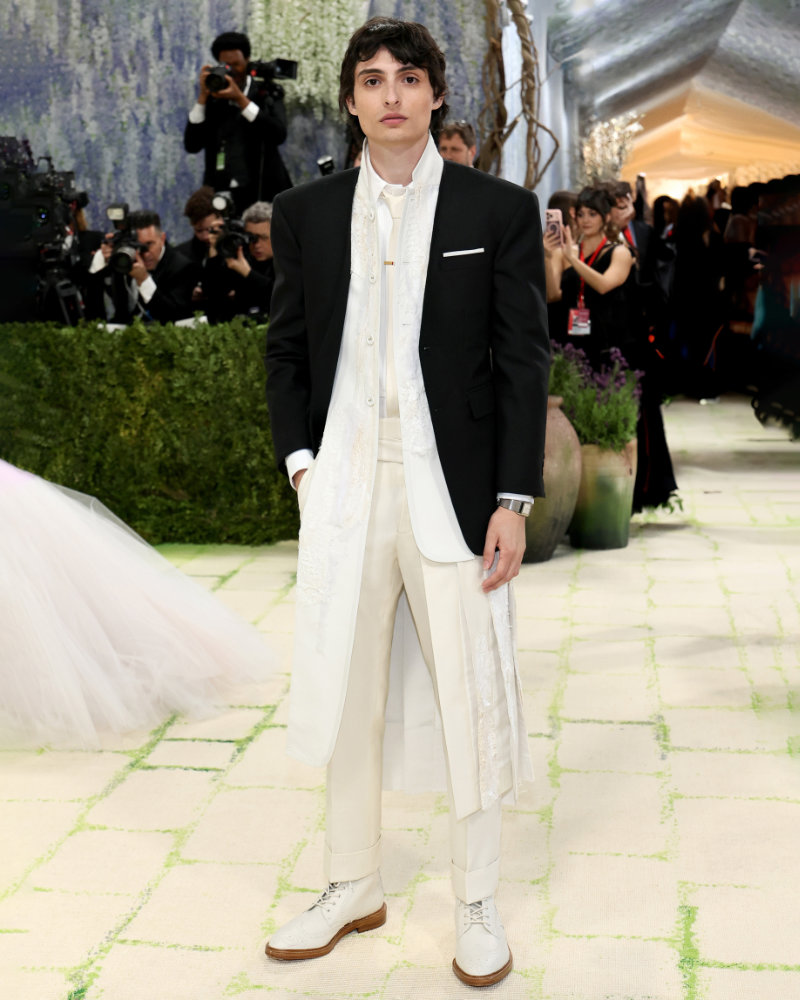
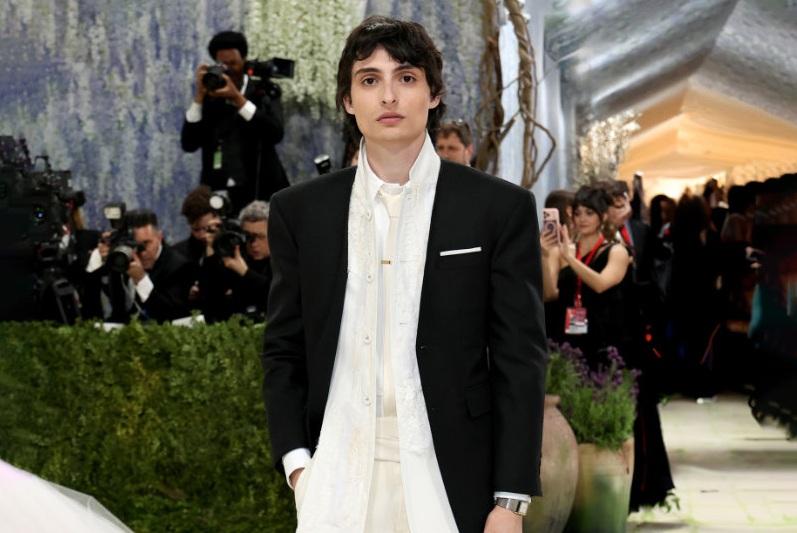
The look played out in black and white: a deconstructed wool and silk faille jacket paired with white wool trousers and a utility-inspired skirt belt. Wingtip boots grounded the silhouette, while the white surfaces were treated as a canvas for layered intervention — hand-applied textures in tweeds, silk faille, organza, lace, and muslin transforming the garment into a collage.
Under the idea of the “reclaimed body,” the ensemble reframed tailoring as reconstruction, where distortion and layering act as structural tools.
Romeo Beckham
Romeo Beckham delivered one of the most effortless readings of classic menswear on the carpet, leaning into understatement over statement. The British model worked within a refined vocabulary defined by ease and precision.
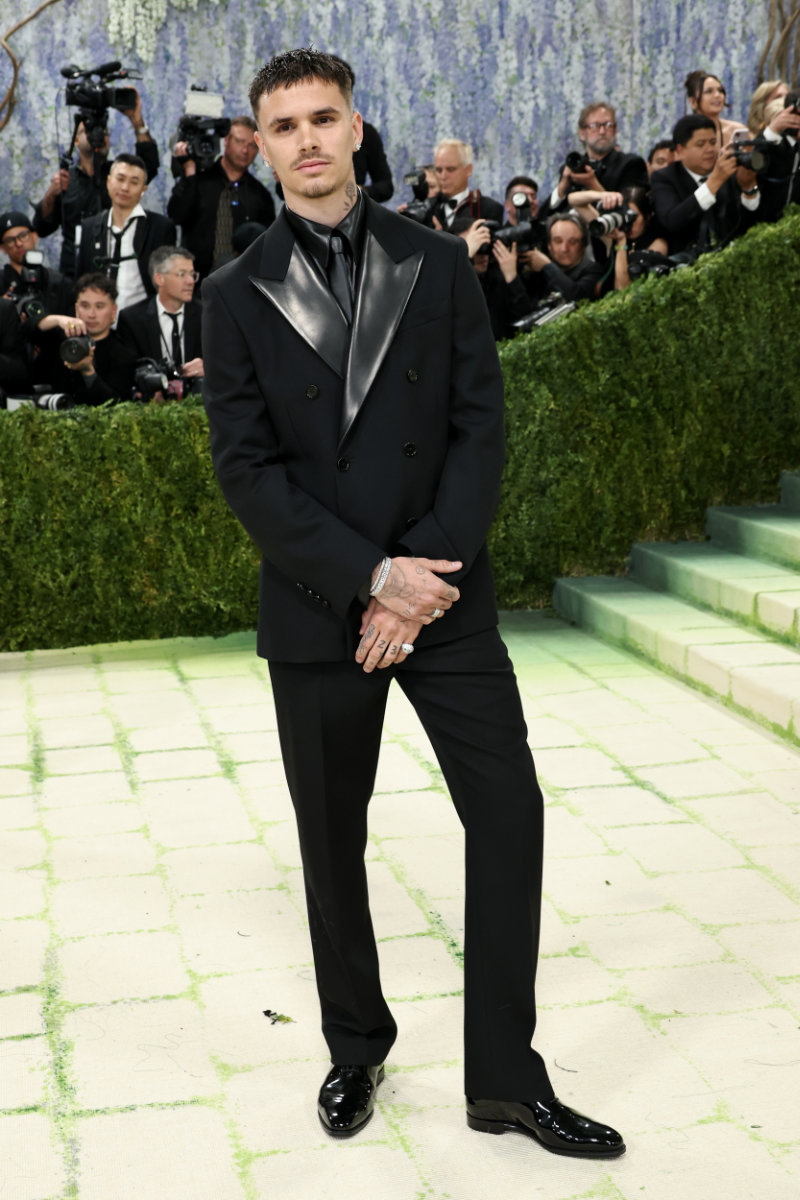
Dressed in Burberry, the tuxedo introduced leather lapels alongside a matching shirt and tie, subtly shifting the traditional silhouette through texture rather than form. Reportedly inspired by Robert Mapplethorpe’s self-portraits, the look balanced discipline with a quiet edge.
In a night defined by experimentation, Beckham stood out precisely for restraint — minimal, controlled, and confidently executed.
Jon Batiste
Last but not least, closing the list, Jon Batiste delivered one of the most conceptually grounded appearances of the evening. Stepping onto the cream-toned carpet in an all-white ensemble, he created a striking visual contrast — almost ethereal in presence — while remaining anchored in the night’s artistic narrative.
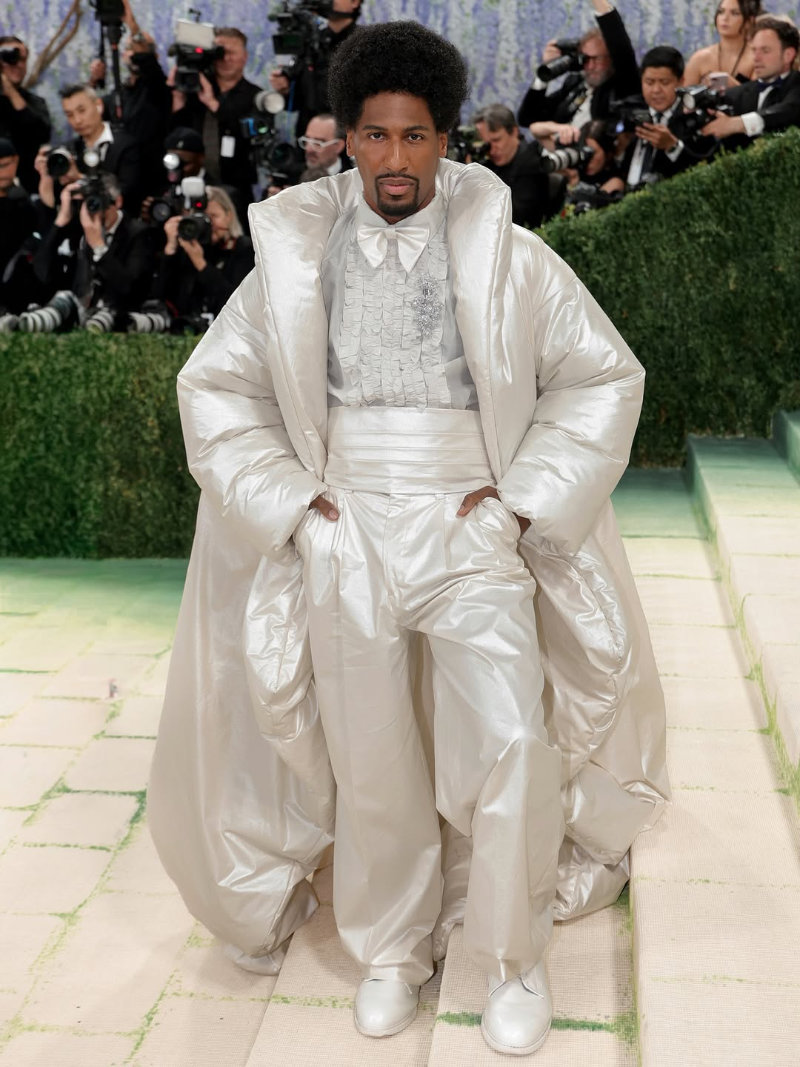
Working with ERL and its founder Eli Russell Linnetz, the look was developed in collaboration with the estate of Barkley L. Hendricks, drawing directly from his 1976 painting Steve. Constructed entirely from deadstock pearlescent and glitter silk taffeta from the same era, the composition echoed Hendricks’ use of monochrome dressing to amplify presence and contrast. Volume, asymmetry, and draping were treated with a sculptural approach, turning the garment into form.
Rather than functioning as a conventional red-carpet statement, the look became a translation of painting into dress. By reducing colour to structure and material, Batiste closed the selection with one of the most resolved interpretations of the theme.
